



5 Best Ways to Manage Personal Finance for Young Adults
5 Best Ways to Manage Personal Finance for Young Adults: A Complete GuideLearn 5 practical ways to manage personal finance for young adults, including budgeting, saving, emergency funds, investing, SIPs, mutual funds, credit cards, debt management and financial goals.
1. Personal Finance for Young Adults: Create a Budget and Track Your Spending
The first step toward better personal finance for young adults is understanding where your money goes. Whether your income comes from a salary, internship, freelance work, allowance or a combination of sources, creating a realistic budget can help you stay in control.
Start by listing your monthly income and regular expenses. Divide your expenses into three simple categories:
- Needs: Food, transportation, education, rent and essential bills.
- Wants: Shopping, entertainment, eating out and subscriptions.
- Financial priorities: Savings, investments and debt payments.
One popular approach is the 50/30/20 budgeting rule: approximately 50% for needs, 30% for wants and 20% for savings and financial goals. However, this is only a guideline. Your ideal budget depends on your income, location and lifestyle.
Track Your Expenses
Expense tracking is one of the easiest ways to improve money management. For one month, record everything you spend. You might discover that food delivery, subscriptions, online shopping or small daily purchases are taking up more money than expected.
You can use a spreadsheet, budgeting app or even a simple notebook. The goal isn’t to stop spending; it is to understand your cash flow and make better decisions.
2. Personal Finance for Young Adults: Save Money and Build an Emergency Fund
Saving money should become a regular financial habit, even if you are only able to save a small amount initially.
Many young adults think they will start saving once they earn more. However, learning to save consistently is more important than waiting for the “perfect” income.
Pay Yourself First
Instead of spending everything and saving whatever is left, set aside your savings first.
For example, if you receive ₹20,000 and decide to save ₹3,000, transfer the ₹3,000 to your savings account before planning your other spending.
Build an Emergency Fund
An emergency fund is money reserved for unexpected expenses such as urgent travel, repairs, essential medical costs or a temporary loss of income.
The amount you need depends on your circumstances. A student living with parents may have different needs from someone paying rent and managing household expenses independently.
Keep emergency savings accessible rather than putting all of it into investments that can fluctuate in value.
Set Clear Financial Goals
Instead of saying, “I want to save more,” make the goal specific.
For example:
“I want to save ₹30,000 for a laptop within 10 months.”
This gives you a clear monthly target of ₹3,000.
Your financial goals might include building an emergency fund, paying education expenses, buying a laptop, travelling, starting investments or preparing for future responsibilities.
3. Personal Finance for Young Adults: Start Investing With SIPs and Mutual Funds
Once you understand your expenses and have appropriate savings, you can start learning about investing.
Investing means putting money into assets with the expectation that they may grow or generate returns. However, investments involve risk, and returns are never guaranteed.
Young adults commonly hear about SIP, mutual funds, stocks, diversification and compound interest.
What Is a SIP?
 SIP stands for Systematic Investment Plan. It is a method of investing a fixed amount regularly into a mutual fund.
For example, an investor could choose to invest ₹1,000 every month instead of investing a large amount at once.
A SIP does not guarantee profits. The results depend on the underlying mutual fund and market performance.
What Are Mutual Funds?
A mutual fund pools money from multiple investors and invests it according to a particular investment strategy.
Different mutual funds have different objectives and risk levels. Before investing, understand:
- Risk level
- Investment horizon
- Fund objective
- Fees and expenses
- Diversification
- Market volatility
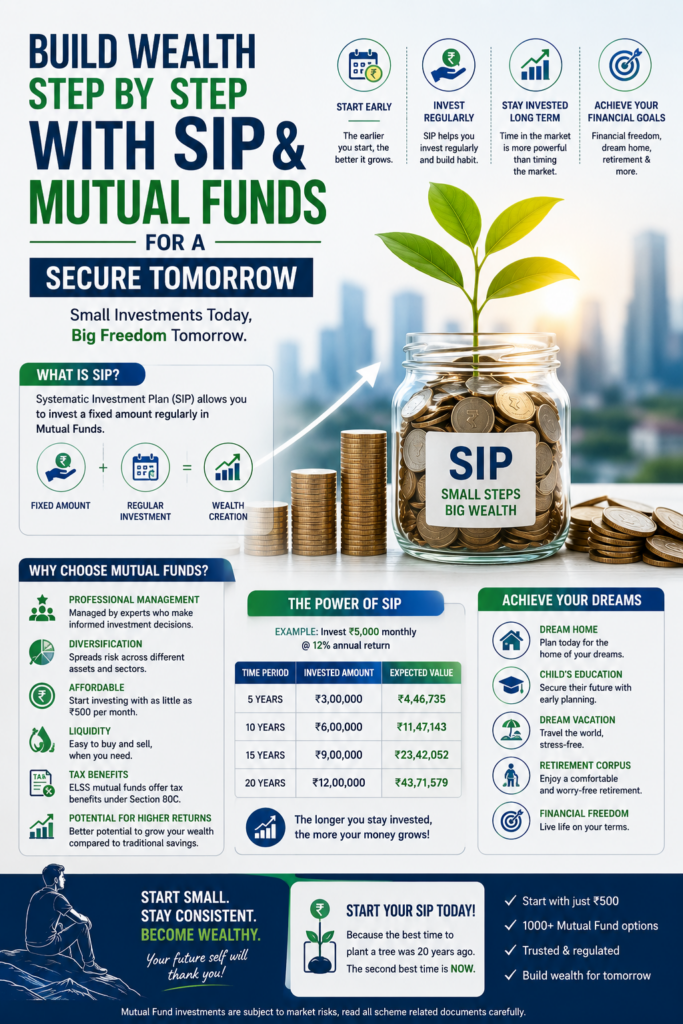
Understand Compound Interest and Diversification
Compound interest allows returns to potentially generate additional returns when money remains invested over time.
Diversification means spreading investments across different assets rather than putting everything into one investment.
Both are important concepts for anyone learning about long-term wealth building, but neither eliminates investment risk.
4. Personal Finance for Young Adults: Manage Credit Cards and Debt
Credit can be useful, but it needs to be handled responsibly.
Credit cards allow you to make purchases and repay the card issuer according to the card’s terms. Interest and other charges may apply when balances aren’t paid as required.
Remember:
Your credit limit is not your income.
If your credit card has a ₹50,000 limit, that doesn’t mean you can afford to spend ₹50,000.
Before using a credit card, understand the interest rate, billing cycle, payment due date, minimum payment, applicable fees and reward conditions.
Understand Your Credit Score
A credit score can become important when applying for certain types of credit. Responsible borrowing and timely payments can help establish a positive credit history.
Practice Debt Management
Debt management involves understanding and controlling your outstanding financial obligations.
If you already have debt, list the amount owed, interest rate, minimum payment and due date. Then create a realistic repayment strategy.
Avoid taking on unnecessary debt simply to maintain a lifestyle that your current income cannot comfortably support.

5. Personal Finance for Young Adults: Set Financial Goals and Build Wealth
Personal finance isn’t only about managing this month’s expenses. It is also about preparing for your future.
As you move from school or college into employment, your income and responsibilities will change. Your financial plan should change with them.
Improve Your Financial Literacy
Financial literacy means having enough knowledge to make informed financial decisions.
Young adults should gradually learn about:
- Budgeting
- Saving
- Investing
- Inflation
- Interest rates
- Taxes
- Insurance
- Credit
- Debt
- Risk management
- Diversification
- Retirement planning
You don’t need to become a financial expert. Understanding the basics can help you avoid expensive mistakes.
Understand Inflation
Inflation means the general level of prices increases over time. As a result, the purchasing power of money can decrease.
Understanding inflation is important when setting long-term savings and investment goals.
Consider Insurance
As you become financially independent, insurance can become an important part of financial planning. Health insurance, for example, can help protect you against certain unexpected healthcare expenses depending on the policy.
Work Toward Financial Independence
Financial independence doesn’t necessarily mean becoming extremely wealthy. For many young adults, it means being able to manage their expenses, handle emergencies and make important life decisions without constantly worrying about money.
Building savings, managing debt, increasing income and investing responsibly can all contribute toward this goal.
5 Best Ways to Manage Personal Finance for Young Adults
Managing money can feel overwhelming when you are just starting your career, living independently, or handling your finances for the first time. From monthly expenses and savings to investments and unexpected costs, young adults have many financial decisions to make.
The good news is that personal finance for young adults does not have to be complicated. Developing a few simple money habits early can help you control your spending, build savings, avoid unnecessary debt, and work toward long-term financial goals.
In this guide, we will explore the 5 best ways to manage personal finance for young adults, including creating a realistic budget, building an emergency fund, setting financial goals, investing early, and managing debt wisely.
Why Is Personal Finance Important for Young Adults?
Your 20s and early 30s are an important period for building your financial foundation. Decisions you make today can influence your financial security for years to come.
Many young adults start earning money but struggle to understand where their income goes. Lifestyle expenses, online shopping, subscriptions, eating out, travel, credit cards, and other expenses can quickly consume a large portion of monthly income.
Learning how to manage personal finance as a young adult can help you:
- Control unnecessary spending
- Save money consistently
- Prepare for unexpected expenses
- Reduce financial stress
- Build a strong credit history
- Start investing early
- Work toward major financial goals
- Develop long-term financial independence
The goal is not to stop enjoying life. Instead, the goal is to create a healthy balance between spending, saving, investing, and enjoying your income.
1. Create a Realistic Monthly Budget
One of the most important steps in managing personal finance is creating a monthly budget.
A budget gives you a clear picture of how much money comes in and where your money goes. Without a budget, it is easy to underestimate small expenses that add up over time.
Start by calculating your monthly take-home income. Then list your essential expenses, such as:
- Rent or accommodation
- Groceries
- Transportation
- Electricity and other utilities
- Phone and internet bills
- Insurance
- Loan or credit-card payments
- Education expenses
After identifying essential expenses, look at your discretionary spending. This can include entertainment, shopping, dining out, subscriptions, hobbies, and travel.
Try the 50/30/20 Budgeting Approach
A simple starting point is the 50/30/20 budgeting method:
50% – Needs:
Essential expenses such as housing, food, transportation, and utilities.
30% – Wants:
Entertainment, shopping, dining, hobbies, subscriptions, and other lifestyle expenses.
20% – Savings and financial goals:
Emergency savings, investments, retirement contributions, and debt repayment.
These percentages are not strict rules. Your ideal budget depends on your income, location, responsibilities, and financial goals.
The most important thing is to create a budget that you can realistically follow every month.
Pro Tip
Track your expenses for at least 30 days. You may be surprised by how much you spend on small purchases such as food delivery, coffee, subscriptions, and impulse shopping.
2. Build an Emergency Fund
The second important step in the 5 best ways to manage personal finance for young adults is building an emergency fund.
An emergency fund is money kept aside for unexpected situations such as:
- Sudden job loss
- Medical expenses
- Urgent repairs
- Family emergencies
- Unexpected travel
- Major household expenses
Without emergency savings, an unexpected expense can force you to rely on credit cards or loans.
How Much Should You Save?
A common long-term target is around 3–6 months of essential living expenses.
However, you do not need to build the entire fund immediately.
If you are starting from zero, begin with a small target such as ₹10,000 or ₹25,000 and gradually increase it.
For example, if your essential monthly expenses are ₹30,000:
3 months = ₹90,000
6 months = ₹1,80,000
Your personal target should depend on factors such as job stability, income, dependents, and monthly expenses.
Make Saving Automatic
One of the easiest personal finance habits is to automate savings.
Set up an automatic transfer shortly after receiving your salary. This helps you save before you have an opportunity to spend the money.
Remember:
Do not save what is left after spending. Spend what is left after saving.
3. Set Clear Financial Goals
Saving money without a specific purpose can be difficult. Setting financial goals gives your money a direction.
Instead of simply saying, “I want to save more,” create specific goals.
For example:
- Save ₹50,000 for an emergency fund
- Save ₹1 lakh for higher education
- Save ₹2 lakh for a car
- Save for a vacation
- Pay off credit-card debt
- Build a retirement corpus
- Save for a home down payment
Use Short-, Medium-, and Long-Term Goals
Divide your financial goals into three categories.
Short-Term Goals
These are goals you want to achieve within the next year or two.
Examples include:
- Building an emergency fund
- Buying a laptop
- Paying off a small debt
- Saving for a vacation
Medium-Term Goals
These may take several years.
Examples include:
- Buying a vehicle
- Higher education
- Starting a business
- Saving for a home
Long-Term Goals
These goals may take 10 years or more.
Examples include:
- Retirement planning
- Buying a home
- Financial independence
- Building long-term wealth
Writing your goals down can make them easier to track.
A simple formula is:
Financial Goal = Amount Required + Deadline + Monthly Contribution
For example:
If you want to save ₹1,20,000 in one year:
₹1,20,000 ÷ 12 = ₹10,000 per month
This makes the goal measurable and easier to follow.
4. Start Investing Early
Saving is important, but saving alone may not be enough to build long-term wealth.
One of the biggest advantages young adults have is time.
Starting to invest early allows your money to potentially benefit from compounding over a longer period.
Depending on your goals, risk tolerance, and financial situation, young investors may explore options such as:
- Mutual funds
- Systematic Investment Plans (SIPs)
- Stocks
- Exchange-traded funds
- Bonds
- Retirement-oriented investments
However, every investment carries some level of risk, and past performance does not guarantee future returns.
What Is an SIP?
A Systematic Investment Plan (SIP) allows an investor to invest a fixed amount into a mutual fund at regular intervals, commonly monthly.
For example, instead of waiting until you have a large amount of money, you might invest ₹500, ₹1,000, ₹5,000, or another affordable amount regularly.
The objective is to develop consistency rather than trying to perfectly predict the market.
Why Start Investing Early?
Consider two people:
Person A starts investing at age 22.
Person B starts investing at age 32.
Even if both invest similar amounts later, Person A has more time for potential compounding.
This is why starting early can be a powerful personal finance habit.
Before Investing
Before investing, consider:
- Your financial goals
- Your investment time horizon
- Your risk tolerance
- Your emergency fund
- Existing high-interest debt
- The type of investment you understand
Do not invest simply because something is trending on social media.
Understand the investment before putting your money into it.
5. Manage Debt and Credit Wisely
The fifth of the 5 best ways to manage personal finance for young adults is learning how to manage debt.
Debt is not automatically bad. Some forms of borrowing can help you pay for education, purchase a home, or manage important expenses.
The problem occurs when high-interest debt becomes difficult to repay.
Credit cards are a common example. If you regularly spend more than you can afford and carry a balance, interest charges can make the original purchase significantly more expensive.
Follow These Credit Card Rules
Try to:
- Pay your credit-card bill on time
- Avoid spending beyond your monthly budget
- Understand interest rates and fees
- Keep track of all outstanding balances
- Avoid unnecessary loans
- Pay high-interest debt aggressively
- Never take debt simply to maintain a lifestyle you cannot afford
If you already have debt, list each balance, interest rate, and minimum payment.
You can then prioritize high-interest debt while continuing to make required payments on other debts.
Build a Healthy Credit History
Responsible credit use can help you establish a strong credit profile.
Paying bills on time, keeping credit utilization under control, and avoiding excessive borrowing are important habits.
Bonus Personal Finance Tips for Young Adults
The five strategies above form a strong foundation, but several additional habits can make managing money easier.
Track Your Net Worth
Your net worth is essentially:
Assets − Liabilities = Net Worth
Assets can include savings, investments, and other valuable assets.
Liabilities include loans, credit-card balances, and other debts.
Tracking your net worth every few months can help you see whether you are moving toward your financial goals.
Avoid Lifestyle Inflation
When your income increases, it can be tempting to immediately increase your spending.
For example, you may move to a more expensive apartment, buy a new phone, eat out more frequently, or upgrade your car.
Instead, consider increasing your savings and investments whenever your income increases.
This allows your lifestyle to improve while your financial foundation becomes stronger.
Review Your Subscriptions
Streaming platforms, apps, memberships, cloud storage, gaming subscriptions, and other recurring expenses can quietly consume money every month.
Review your subscriptions regularly and cancel services you rarely use.
Even saving ₹1,000 per month means:
₹1,000 × 12 = ₹12,000 per year
Small savings can become meaningful over time.
Learn Basic Financial Concepts
You do not need to become a financial expert.
However, every young adult should understand basic concepts such as:
- Budgeting
- Saving
- Inflation
- Compound interest
- Mutual funds
- SIPs
- Credit scores
- Insurance
- Taxes
- Retirement planning
- Investment risk
The more financially educated you become, the more confidently you can make money decisions.
Common Personal Finance Mistakes Young Adults Should Avoid
Understanding what not to do is just as important as knowing what to do.
1. Spending Everything You Earn
A higher salary does not automatically mean better finances. If your expenses increase at the same rate as your income, you may still struggle to save.
2. Ignoring Emergency Savings
Unexpected expenses are part of life. Having savings can prevent emergencies from becoming financial crises.
3. Investing Without Understanding Risk
Do not invest simply because friends, influencers, or social media recommend something.
4. Relying Too Much on Credit Cards
Credit cards should be a payment tool, not an excuse to spend beyond your means.
5. Delaying Retirement Planning
You may feel retirement is decades away, but starting early gives your investments more time to potentially grow.
6. Not Having Financial Goals
Without goals, it is easy to spend money without knowing whether your spending supports your future plans.
A Simple Monthly Personal Finance Routine
If managing your money feels complicated, start with this simple monthly routine:
Step 1: Check your income.
Step 2: Review last month’s expenses.
Step 3: Create the current month’s budget.
Step 4: Transfer money to savings.
Step 5: Contribute toward your investment goals if appropriate.
Step 6: Pay bills and debt on time.
Step 7: Review your financial goals.
Step 8: Track your progress.
This routine can take less than an hour but can make a significant difference over time.
Learning 5 best ways to manage personal finance for young adults is not about becoming wealthy overnight. It is about developing consistent financial habits that can support your future.
Start by creating a realistic budget, build an emergency fund, set clear financial goals, invest according to your goals and risk tolerance, and manage debt responsibly.
You do not need a huge income to begin managing your finances better. Even small improvements can create meaningful results when you remain consistent.
The most important financial habit is to start early, stay disciplined, and make your money work toward your goals.
Your financial future is built through the decisions you make today.
Common Personal Finance Mistakes Young Adults Should Avoid
Even financially responsible people make mistakes. Some common ones include:
- Spending more whenever income increases
- Not tracking expenses
- Investing without understanding risk
- Keeping no emergency savings
- Using credit cards without understanding repayment
- Following financial influencers blindly
- Chasing unrealistic returns
- Ignoring insurance and taxes
- Taking unnecessary debt
Avoiding these mistakes can be just as important as learning how to invest.
Financial Habits Every Young Adult Should Develop
Building strong financial habits early can make money management much easier.
Try to:
- Track your expenses every month.
- Save a fixed amount regularly.
- Build an emergency fund.
- Learn before investing.
- Understand credit and debt.
- Review your financial goals regularly.
- Continue improving your financial literacy.
Small habits can become powerful when they are repeated consistently.
FAQ:5 Best ways to manage Personal Finance for Young Adults
How should young adults manage their money?
Young adults should start with a realistic budget, track expenses, save consistently, build an emergency fund and gradually learn about investing and debt management.
How much should a young adult save?
There is no single amount that works for everyone. Start with an amount you can save consistently while covering your essential expenses, then gradually increase your savings as your income grows.
Should young adults start investing?
Young adults can begin learning about investing early, but they should understand investment risks, maintain appropriate emergency savings and choose investments according to their goals and risk tolerance.
Is a SIP suitable for beginners?
A SIP can be a convenient way to invest a fixed amount regularly in a mutual fund. However, the underlying investment carries risk, so investors should understand the fund before investing.
How can students start managing personal finance?
Students can begin by tracking their allowance or income, creating a simple budget, controlling unnecessary spending, saving regularly and learning basic financial concepts.
What are the 5 best ways to manage personal finance for young adults?
The five important strategies are creating a budget, building an emergency fund, setting financial goals, investing early, and managing debt and credit responsibly.
How much money should a young adult save each month?
There is no single amount that works for everyone. A useful starting point is to save a percentage of your income consistently while accounting for your essential expenses, debt, and financial goals.
Should young adults save or invest first?
Building an emergency fund and handling high-interest debt should generally come before taking significant investment risks. Once your financial foundation is stronger, you can consider investments that match your goals and risk tolerance.
Is SIP a good option for young investors?
A SIP can be a convenient way to invest regularly in mutual funds. However, mutual funds are subject to market risk, and investors should choose investments based on their goals, time horizon, and risk tolerance.
How can young adults avoid financial stress?
Creating a budget, maintaining emergency savings, avoiding unnecessary debt, setting realistic goals, and reviewing finances regularly can help young adults manage their money with greater confidence.
What is the biggest personal finance mistake young adults make?
One common mistake is spending most or all of their income without building savings or investing for future goals. Developing good money habits early can make long-term financial planning easier.
Conclusion: Building Better Personal Finance Habits as a Young Adult
Learning personal finance for young adults doesn’t require complicated strategies or a high income. It starts with small and consistent decisions.
The five key steps are to create a budget, save consistently, build an emergency fund, learn about investing and manage credit responsibly.
Remember that personal finance is personal. Your ideal budget, savings target and investment choices depend on your income, expenses, responsibilities, financial goals and risk tolerance.
Start with what you can manage today. Track your money, keep learning and make financial decisions based on knowledge rather than pressure or trends.
The financial habits you develop today can become the foundation for greater financial confidence, stability and independence in the future.
FOLLOW ON INSTAGRAM
[…] ALSO READ : 5 Best ways to manage Personal Finance for Young Adults. […]