



7 Best Ways to Use ChatGPT for Studying Without Depending on It
Introduction
Artificial intelligence has changed the way students learn, research, revise, and prepare for examinations. Among the many AI tools available today, ChatGPT can be a useful study assistant when it is used correctly. However, relying on AI for every question can reduce independent thinking, problem-solving ability, and genuine understanding.
The best approach is to use ChatGPT as a learning assistant rather than a replacement for your own brain.
Whether you are preparing for school examinations, college assignments, competitive exams, or learning skills that could eventually help you explore opportunities such as how to make money online, ChatGPT can support your learning process without doing all the work for you.
Here are 7 effective ways to use ChatGPT for studying without becoming dependent on it.
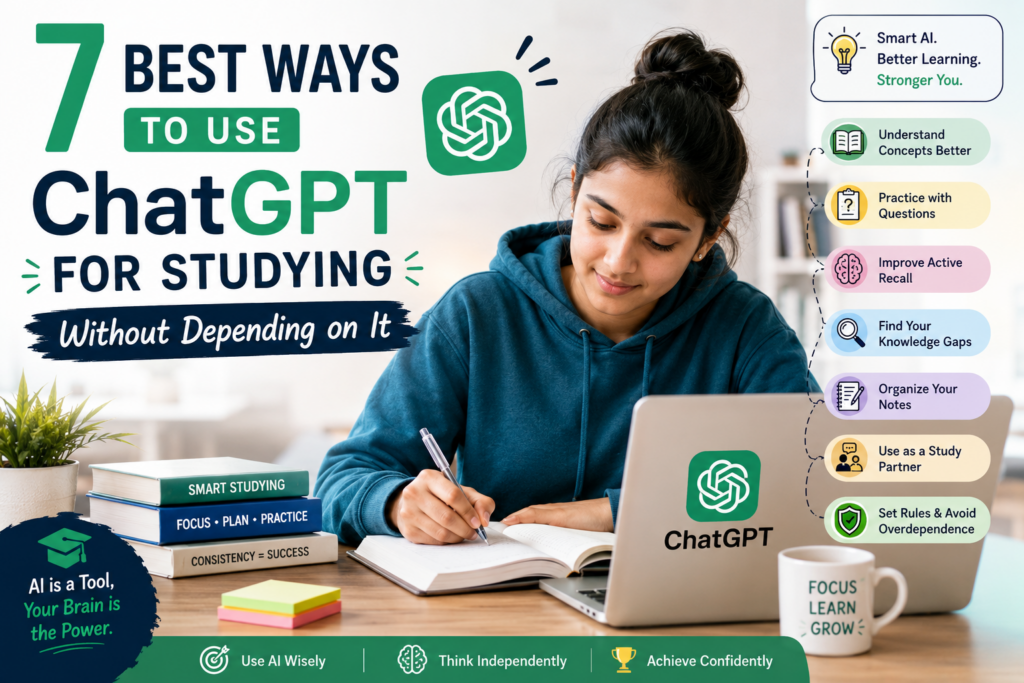
1. Use ChatGPT to Understand Difficult Concepts
One of the best ways to use ChatGPT for studying is to ask it to explain difficult concepts in simple language.
Instead of asking:
“Give me the answer.”
Try asking:
“Explain this concept in simple language and give me an everyday example.”
For example, if you are studying economics and don’t understand inflation, you can ask ChatGPT to explain inflation using a simple real-life situation.
You can also request different levels of explanation:
- Explain it like I’m a beginner.
- Explain it at a college level.
- Give me a real-world example.
- Explain the concept step by step.
- Compare it with a similar concept.
This approach helps you understand the subject instead of simply copying an answer.
2. Ask ChatGPT to Create Practice Questions
Another excellent way to use ChatGPT for studying is to turn it into a practice-question generator.
After completing a chapter, ask ChatGPT to create:
- Multiple-choice questions
- Short-answer questions
- Long-answer questions
- True/false questions
- Case-study questions
- Application-based questions
- Revision quizzes
For example:
“Create 15 questions based on this chapter. Don’t give me the answers until I attempt them.”
This makes your study session more interactive.
Even better, answer the questions without looking at your textbook or ChatGPT. Then use AI to check your responses and identify areas where you need more practice.
3. Use ChatGPT for Active Recall
Active recall is much more useful than repeatedly reading the same notes.
Instead of asking ChatGPT to summarize your entire textbook, use it to test what you already know.
For example, you can say:
“Quiz me on this topic one question at a time. Wait for my answer before giving me the next question.”
This creates a simple study cycle:
Learn → Close your notes → Recall → Answer → Check → Improve
The important part is that you attempt the answer first.
If ChatGPT immediately provides everything, your brain does less work. If you attempt the answer yourself and then use AI for feedback, ChatGPT becomes a tool for strengthening your learning.
4. Use ChatGPT to Find Your Knowledge Gaps
Sometimes students think they understand a chapter because the notes look familiar. However, recognition is not the same as understanding.
ChatGPT can help identify your weak areas.
Ask questions such as:
“Give me a quiz on this chapter and identify the topics I struggle with.”
Or:
“Based on my answers, tell me which concepts I should revise.”
You can then create a personal revision list.
For example:
Topics I understand
- Basic concepts
- Definitions
- Simple applications
Topics I need to revise
- Complex applications
- Formulas
- Case studies
- Important exceptions
This makes your study time more efficient because you focus on areas that actually need improvement.
 5. Use ChatGPT to Improve Your Notes—Not Replace Them
ChatGPT can help turn messy information into structured study material.
You can ask it to organize your own notes into:
- Headings
- Bullet points
- Definitions
- Key concepts
- Examples
- Revision questions
- Important terms
For example:
“Organize these notes into a one-page revision sheet. Don’t add information that isn’t present in my notes.”
This is particularly useful before examinations.
However, don’t make the mistake of studying only AI-generated notes. Your textbook, class material, teacher’s instructions, and official study resources should remain your primary sources.
Use ChatGPT to organize and clarify information rather than replacing your original learning material.
6. Use ChatGPT as a Study Partner, Not an Answer Machine
One of the biggest mistakes students make with AI is using it as an answer machine.
They receive an assignment, paste the question into ChatGPT, copy the response, and move on.
This may save time, but it doesn’t necessarily create learning.
Instead, treat ChatGPT like a study partner.
For example:
“Don’t solve this problem. Give me one hint at a time so I can solve it myself.”
Or:
“Check my solution and tell me where my reasoning went wrong without giving me the final answer.”
This method forces you to think.
The same principle applies when learning practical skills. If you’re researching subjects such as digital marketing, freelancing, content creation, or how to make money online, don’t simply ask AI to give you a finished business plan. Ask it to challenge your ideas, identify weaknesses, and help you develop your own solution.
7. Set Rules to Prevent AI Dependence
The final and perhaps most important strategy is to establish boundaries.
Before using ChatGPT, create a few personal rules.
For example:
The 20-Minute Rule
Try solving a difficult problem yourself for 20 minutes before asking AI for help.
The Attempt-First Rule
Never ask ChatGPT for the final answer before making your own attempt.
The Explain-Back Rule
After ChatGPT explains something, close the conversation and explain the concept in your own words.
The Verification Rule
For important academic information, verify facts using your textbook, teacher, official sources, or reliable references.
The No-Copy Rule
Don’t submit AI-generated answers as your own work when your school or university expects independent work.
These simple rules allow you to benefit from AI while continuing to develop independent thinking.
How to Use ChatGPT Without Becoming Dependent
A simple formula can help:
Your Brain → ChatGPT → Your Brain Again
Don’t make it:
Question → ChatGPT → Copy → Submit
Instead:
Question → Think → Attempt → Ask ChatGPT → Understand → Verify → Rewrite in Your Own Words
This approach makes ChatGPT a study accelerator rather than a substitute for studying.
Can ChatGPT Help Students Learn Skills for Making Money Online?
Yes, ChatGPT can also be useful when learning practical skills that may eventually help you explore how to make money online.
For example, students can use AI to learn about:
- Digital marketing
- SEO
- Content writing
- Graphic design
- Website development
- Social media marketing
- Video editing
- Freelancing
- Affiliate marketing
- Online business
However, knowing how to make money online requires more than simply asking AI for ideas.
You still need to develop a real skill, practice it, create a portfolio, understand your target audience, and learn how to provide value to clients or customers.
For example, instead of asking:
“How can I make money online?”
A better learning prompt is:
“I want to learn SEO as a beginner. Create a 30-day learning plan with practical exercises and projects. Don’t give me the answers to the exercises unless I ask.”
This transforms ChatGPT from an information generator into a structured learning partner.
One of the biggest advantages of AI is personalization.
Instead of following the same study schedule as everyone else, you can provide ChatGPT with information about your subjects, available study time, upcoming exams, and difficult topics.
For example, you can write:
“I have four subjects and 30 days before my examination. I can study three hours every day. Create a realistic study plan and include revision and practice tests.”
ChatGPT can then help you organize your available time.
You can divide your schedule into:
Learning → Practice → Revision → Testing → Improvement
This approach can make studying more organized and reduce last-minute preparation.
Additional Section: Use ChatGPT to Practice Before Exams
Before an examination, students should spend time solving questions rather than only reading notes.
You can ask ChatGPT to create a mock examination based on the topics you have studied.
For example:
“Create a 50-question mock test based on these five chapters. Include easy, medium, and difficult questions. Don’t provide answers until I finish.”
After completing the test, you can ask ChatGPT to analyze your performance.
It can help you identify:
- Topics you frequently get wrong
- Types of questions you struggle with
- Concepts that require revision
- Areas where your reasoning needs improvement
- Questions that require additional practice
This turns AI into a personalized practice partner.
Additional Section: Use the Feynman Technique With ChatGPT
Another useful strategy is the Feynman Technique.
First, study a topic independently. Then close your textbook and explain the concept in your own words.
After that, ask ChatGPT to evaluate your explanation.
For example:
“Here is my explanation of photosynthesis. Check whether I have understood the concept correctly. Don’t rewrite it completely. Point out only the areas I need to improve.”
This approach is useful because you are required to recall and explain the concept yourself instead of simply reading an AI-generated explanation.
Additional Section: Turn ChatGPT Into a Revision Coach
Revision becomes easier when you divide large topics into smaller sections.
You can ask ChatGPT to create:
- Daily revision questions
- Flashcards
- One-minute quizzes
- Important definitions
- Formula revision
- Topic comparisons
- Common mistakes
- Concept-based questions
For example:
“Give me 10 quick questions about this chapter. Ask them one at a time and don’t show the answers until I respond.”
Short revision sessions can be particularly useful when preparing for examinations.
Additional Section: ChatGPT and Career-Oriented Learning
Students should not focus only on academic knowledge. Developing practical skills can also help them prepare for future opportunities.
If you’re exploring how to make money online, start by asking yourself:
What skill can I develop that provides value to another person or business?
For example, someone interested in content writing can learn:
- Writing fundamentals
- SEO basics
- Keyword research
- Content structure
- Editing
- Portfolio creation
- Client communication
Someone interested in digital marketing can learn:
- SEO
- Social media marketing
- Paid advertising
- Analytics
- Content strategy
- Email marketing
- Conversion optimization
ChatGPT can help create learning roadmaps, exercises, project ideas, and feedback systems for these skills.
The important point is that learning a skill comes before trying to monetize it.
Additional Section: Avoid These Common ChatGPT Study Mistakes
While ChatGPT can be extremely useful, students should avoid several common mistakes.
1. Asking for Complete Answers Immediately
If you always ask for the final answer, you lose the opportunity to practice problem-solving.
2. Studying Only AI-Generated Notes
AI-generated material should not replace textbooks, lectures, official resources, or teacher guidance.
3. Not Checking Information
AI can sometimes produce inaccurate or incomplete information. Important academic information should be verified using reliable sources.
4. Using AI for Every Small Question
Try thinking independently before asking AI.
5. Copying AI Responses
Understanding and rewriting information in your own words is much more valuable than simply copying an AI response.
Additional Section: 10 Useful ChatGPT Study Prompts
You can add a dedicated “ChatGPT prompts for students” section to increase the practical value of your article.
- Concept Explanation Prompt
“Explain this topic in simple language and give me a real-world example.” - Quiz Prompt
“Quiz me on this chapter one question at a time.” - Revision Prompt
“Create a one-page revision guide from these notes.” - Exam Prompt
“Create a mock test based on these topics.” - Active Recall Prompt
“Ask me questions that test whether I actually remember this topic.” - Weakness Prompt
Conclusion
ChatGPT can make studying faster, more interactive, and more personalized, but it should never replace your own thinking.
The 7 best ways to use ChatGPT for studying are to use it for understanding difficult concepts, generating practice questions, active recall, identifying knowledge gaps, organizing notes, receiving guided assistance, and creating boundaries against overdependence.
The goal isn’t to study with AI instead of your brain.
The goal is to study with AI while making your brain work harder.
And if you’re also interested in learning skills related to how to make money online, use the same philosophy: let AI help you learn faster, but build the actual skills through practice and real-world experience.