


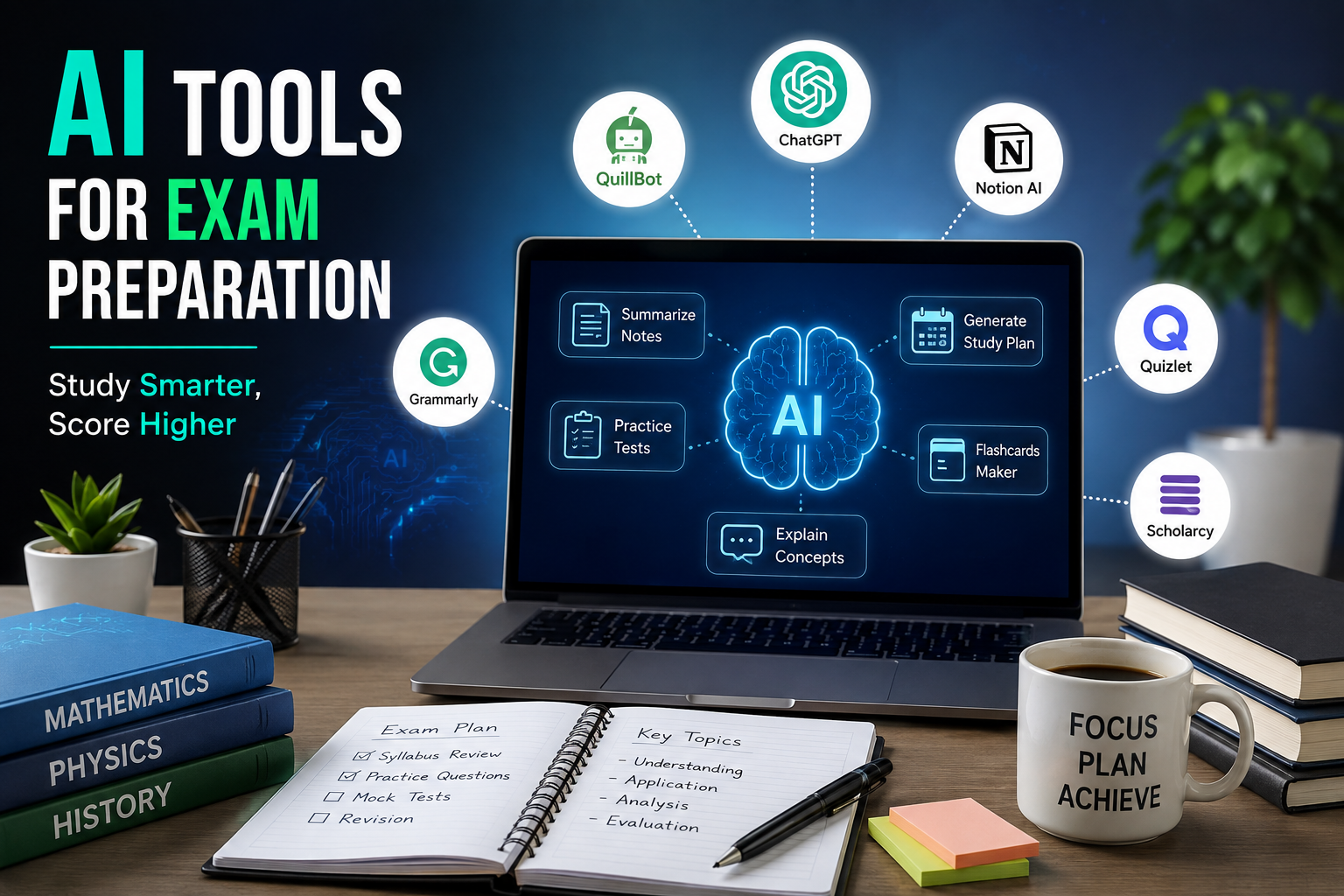
AI Tools for Exam Preparation: Study Smarter, Not Harder
Exam preparation has changed dramatically over the last few years. Students no longer have to depend only on textbooks, handwritten notes, and hours of searching for explanations online. Today, AI study tools can help organize information, explain difficult concepts, create practice material, and make revision more structured.
But using AI for studying does not mean asking a chatbot to do all your work. The most effective approach is to use artificial intelligence as a study assistant, while you remain responsible for understanding, practicing, and remembering the material.
Imagine preparing for an economics exam. You have 50 pages of notes, several chapters to revise, and only a few days left. Instead of repeatedly reading everything from beginning to end, you can use AI to organize your notes, identify important concepts, create practice questions, and build a realistic study schedule.
That is where AI can make a real difference.
From AI tutoring and personalized learning to flashcards, quiz generation, and notes/PDF summarization, these tools can support different stages of exam preparation. The key is knowing when and how to use them.
1. How AI Tools Can Make Exam Preparation More Efficient
One of the biggest problems students face before exams is not necessarily a lack of study material. It is having too much information and not knowing where to start.
AI can help turn a large amount of information into a more manageable learning process.
For example, suppose you have an upcoming business studies exam covering five chapters. You could use an AI tool to help organize the topics into smaller sections and create a revision sequence based on your available time.
This is where study plans become useful.
Instead of simply writing “Study Business Studies” on your timetable, you can divide your preparation into specific tasks:
- Monday: Revise Chapter 1 concepts
- Tuesday: Study Chapter 2 and create flashcards
- Wednesday: Practice questions from Chapters 1 and 2
- Thursday: Revise difficult concepts
- Friday: Take a self-test
- Weekend: Full revision and weak-topic practice
A good AI-generated plan can give you structure, but it should still be adjusted according to your syllabus, examination date, current preparation level, and personal schedule.
AI can also help break down difficult concepts
Another advantage is getting explanations at different levels of difficulty.
If a student does not understand a particular economics concept, they can ask an AI tool to explain it in simpler language, provide an everyday example, or compare it with a related concept.
For instance, instead of memorizing a definition of price elasticity, a student could ask for a simple real-world example involving the price of a product and changes in consumer demand.
This makes learning more interactive rather than purely based on memorization.
The important thing is to check AI-generated explanations against your textbook, teacher’s notes, and syllabus, because AI tools can sometimes provide incomplete or inaccurate information.
2. AI Tutoring and Personalized Learning
Traditional classrooms generally follow one teaching pace. However, students do not all learn at the same speed.
Some students understand a concept immediately, while others need multiple examples before it becomes clear. This is where AI tutoring can be particularly useful.
An AI tutor can help a student ask follow-up questions without feeling embarrassed about asking the same thing several times.
For example:
“Explain this accounting concept in simple terms.”
If the explanation is still confusing, the student can ask:
“Give me a numerical example.”
Then:
“Give me a practice question without showing the answer.”
This creates a learning conversation rather than simply providing a definition.
Personalized learning
Personalized learning is another major advantage of AI.
Instead of giving every student exactly the same material, AI can help create content based on individual needs.
A student who struggles with mathematics might request basic questions first and gradually increase the difficulty. Another student who already understands the basics might move directly to application-based questions.
This can make study sessions more efficient.
For example, after completing a practice test, you might identify three weak areas:
- Percentage calculations
- Simple interest
- Profit and loss
Instead of spending equal amounts of time on every mathematics topic, you could focus more heavily on these three areas.
AI can help organize that revision.
However, personalization should not become dependence. Students still need to solve questions independently and develop their own understanding.
3. Turn Notes and PDFs Into Useful Study Material
Students often spend a huge amount of time reading lengthy PDFs, lecture notes, articles, and study material.
This is where notes/PDF summarization can save time.
AI tools can help turn lengthy material into:
- Key points
- Short summaries
- Definitions
- Important concepts
- Question-and-answer formats
- Revision notes
- Topic-wise explanations
For example, imagine you have a 40-page chapter on marketing. Instead of asking AI to summarize the entire chapter and memorizing the output blindly, you can use the summary as a starting point.
You might ask for:
Step 1: A chapter overview.
Step 2: The major concepts.
Step 3: Important definitions.
Step 4: Examples for difficult concepts.
Step 5: Potential exam questions.
Step 6: A short revision sheet.
This approach turns passive reading into active learning.
Why you shouldn’t rely entirely on summaries
There is an important limitation.
A summary may leave out details that your teacher considers important. An AI tool may also misunderstand a table, formula, diagram, or context.
Therefore, summaries should be used mainly for revision and organization, rather than replacing the original study material.
A good rule is:
Learn from the original material → use AI to organize it → return to the original material when something is unclear.
That gives you the benefits of AI without losing important information.

4. Practice Questions, Flashcards and Quiz Generation
Reading notes can make you feel prepared, but recognizing information is not the same as being able to recall it during an exam.
This is why active practice matters.
AI can help students create practice questions based on the topics they have studied.
For example, after completing a chapter, you can ask an AI tool to create:
- Multiple-choice questions
- Short-answer questions
- Long-answer questions
- Application-based questions
- Case-study questions
- True/false questions
You can even ask for questions without answers first so that you can test yourself honestly.
Flashcards for quick revision
Flashcards are another simple but powerful study method.
A flashcard can contain a question on one side and the answer on the other.
For example:
Question: What is opportunity cost?
Answer: The value of the next best alternative that is forgone when a choice is made.
AI can help generate dozens of flashcards from a chapter in a short amount of time.
Students can then use these cards for quick revision while travelling, taking a short break, or reviewing a topic before an exam.
However, flashcards work best for information that benefits from repeated recall, such as:
- Definitions
- Formulas
- Key terms
- Dates
- Concepts
- Important facts
They are less useful when a subject requires detailed reasoning or problem-solving unless they are combined with actual question practice.
Quiz generation for self-testing
Quiz generation takes this idea one step further.
Instead of simply reading questions, students can create a mini-test after finishing a topic.
For example:
“Create a 15-question quiz on the chapter, with medium-difficulty questions. Do not provide the answers until I submit my responses.”
After completing the quiz, you can review your mistakes and identify weak areas.
This creates a simple learning cycle:
Study → Test → Identify mistakes → Revise → Test again
That cycle is much more useful than repeatedly reading the same notes.

5. Creating Better Study Guides and Smarter Revision Strategies
Another practical application of AI is creating study guides.
A study guide is essentially a structured roadmap of what you need to know before an examination.
For example, if a chapter contains ten major concepts, an AI tool can help organize them into a checklist:
Chapter Revision Guide
Concept 1: Definition and meaning
Concept 2: Features
Concept 3: Importance
Concept 4: Advantages and disadvantages
Concept 5: Real-world applications
Concept 6: Important formulas
Concept 7: Common mistakes
Concept 8: Practice questions
This structure can make revision less overwhelming.
Students can also ask AI to identify relationships between concepts.
For example, in economics, several topics may be connected. Understanding those relationships can be more valuable than memorizing isolated definitions.
Use AI to find your weak areas
One of the smartest ways to use AI during exam preparation is not simply asking:
“What should I study?”
Instead, ask:
“Based on the questions I got wrong, what topics do I need to revise?”
Suppose you answer 20 questions and get six wrong. If four mistakes involve the same concept, that is a clear signal that the topic needs more attention.
You can then create a targeted revision session instead of starting the entire chapter again.
This makes your preparation more efficient.
How to Use AI Without Becoming Dependent on It
AI can be extremely useful, but there is a difference between using AI to learn and using AI instead of learning.
If you ask AI for the answer to every homework question, copy it, and move on, you may finish your work quickly but learn very little.
A better approach is to use AI as a tutor.
For example:
Instead of:
“Give me the answer.”
Try:
“Give me a hint.”
Then attempt the question yourself.
You can also ask:
“Check my solution and tell me where I went wrong without giving me the complete answer.”
This encourages problem-solving.
Always verify important information
AI-generated information should not automatically be treated as fact.
Before using information in an important assignment or examination, compare it with reliable sources such as:
- Your textbook
- Teacher’s notes
- Official educational websites
- Government sources
- Academic resources
This is particularly important for formulas, statistics, historical information, scientific facts, and current affairs.
Protect your privacy
Students should also avoid entering sensitive personal information into AI tools.
There is rarely a reason to share private details when asking for help with an academic topic.
A Simple AI-Powered Exam Preparation Workflow
You don’t need ten different tools to improve your studying. A simple workflow can be enough.
Step 1: Understand
Start with your textbook, class notes, or official study material.
Step 2: Clarify
If a concept is confusing, use AI tutoring to request a simpler explanation or example.
Step 3: Summarize
Use notes/PDF summarization to organize lengthy material into revision points.
Step 4: Create a Study Guide
Turn the chapter into a structured study guide containing important concepts and areas to revise.
Step 5: Build a Study Plan
Create realistic study plans based on your exam date and available time.
Step 6: Practice
Generate practice questions and solve them without looking at the answers.
Step 7: Test Yourself
Use quiz generation to create a short test.
Step 8: Revise Weak Areas
Use personalized learning to spend additional time on topics where you made mistakes.
Step 9: Repeat
Test yourself again after revision.
This process makes AI a support system rather than a shortcut.
Conclusion: Ai tools for Exam Preparation
The rise of AI tools for exam preparation gives students access to a new kind of digital study assistant. From AI tutoring and personalized learning to practice questions, flashcards, quiz generation, and notes/PDF summarization, these tools can make studying more organized and interactive.
The biggest benefit, however, isn’t simply saving time. It is being able to create a more structured learning process.
Instead of spending hours wondering what to study next, you can create focused study plans. Instead of rereading the same chapter repeatedly, you can create practice tests. Instead of getting stuck on a difficult concept, you can ask for another explanation.
But remember: AI should support your learning, not replace it.
The strongest approach is simple: understand the material yourself, use AI to practice and organize it, verify important information, and test your knowledge regularly.
If you are preparing for an upcoming exam, start with one chapter today. Use AI to create a study guide, generate practice questions, and identify the areas you need to revise. Over time, this small change can turn exam preparation from a stressful last-minute task into a more organized and confident process.
follow on Instagram